
Choosing the right and best multi-client 3PL software is not just a technical decision. It determines how efficiently you bill clients, how clearly inventory is separated, and how confidently your warehouse operation can scale.
If you manage multiple brands inside one warehouse, the system behind your operation needs to handle more than picking and shipping. It must support client-specific billing, reporting access, integrations, and controlled inventory separation without constant manual correction.
Below are several widely evaluated 3PL software platforms in 2026, along with the types of operations they tend to support.
The quick comparison table below highlights how these multi-client 3PL software platforms differ in terms of client portals and billing capabilities.
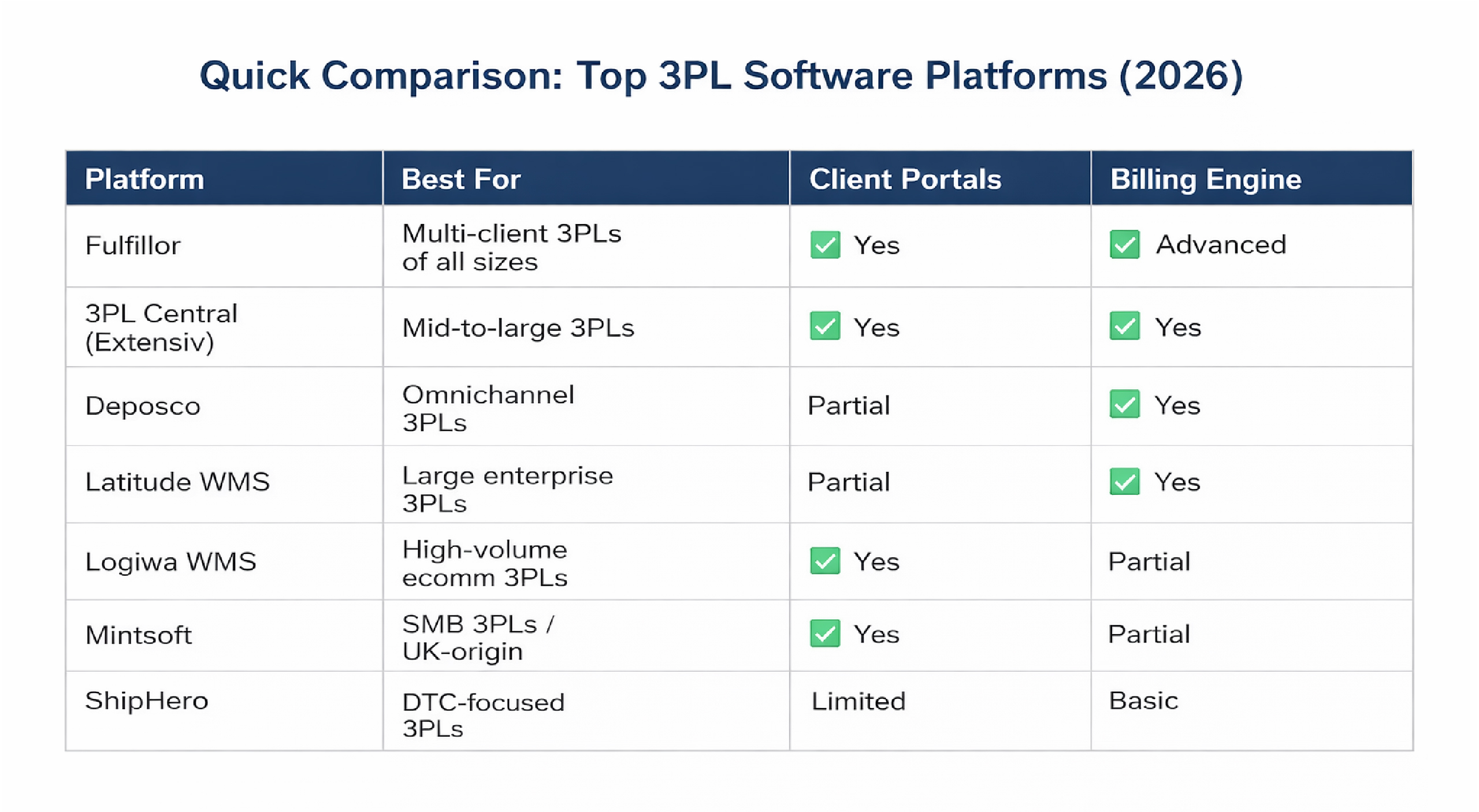
This comparison highlights which platforms offer structured billing, client portals, and scalable multi-warehouse support.
1. Fulfillor
Fulfillor is designed specifically for multi-client 3PL warehouse environments and functions as a complete 3PL warehouse management system. The system focuses on structured client separation, configurable billing logic, and real-time visibility for both operators and clients.
Storage charges, pick fees, and returns are captured automatically inside the system instead of being reconstructed later in a spreadsheet.
Each client receives dedicated portal access to view inventory, orders, and shipment status.
Carrier integrations include major US providers such as UPS, FedEx, and USPS, and ecommerce integrations connect with platforms like Shopify and Amazon.
Fulfillor is commonly evaluated by growing and mid-sized 3PL operators seeking scalable billing automation without enterprise-level implementation complexity.
2. Extensiv
Extensiv has been around long enough that most US 3PL operators have at least evaluated it once. Some adopt it early. Others move to it later when retail compliance becomes a bigger part of the business.
The platform supports multi-client environments, EDI connectivity, billing automation, and customer portals. It is often considered by 3PLs working with larger retail accounts that require structured EDI workflows.
3. Deposco
Deposco positions itself as a broader supply chain solution that includes warehouse and order management.
It is commonly evaluated by 3PLs serving clients with complex omnichannel requirements, including B2C and B2B operations within the same facility.
4. Latitude WMS
Latitude WMS is typically associated with large distribution environments that require advanced warehouse control.
3PLs operating high-volume facilities or distribution-focused models may consider Latitude for its operational depth and configuration capabilities.
5. Logiwa
Logiwa is often selected by ecommerce-heavy 3PL operators focused on fast order processing and ecommerce channel integration.
It is visible in conversations among fulfillment providers serving di
rect-to-consumer brands.
6. Mintsoft
Mintsoft originated in the UK and is generally considered by smaller fulfillment operations looking for cloud-based systems with accessible implementation.
It appears frequently in early-stage 3PL evaluations.
7. ShipHero
ShipHero began as ecommerce fulfillment software and later expanded to support 3PL environments.
It is commonly explored by fulfillment providers serving DTC brands and operating their own warehouse facilities.
Core Capabilities to Evaluate in Multi-Client 3PL Software
When reviewing 3PL software, focus on how the system performs in real warehouse scenarios rather than relying on surface-level feature lists.
Strong 3PL billing software should accurately capture storage, pick fees, special handling, and returns without manual reconciliation.
Inventory separation must prevent cross-client reporting overlap while maintaining operational efficiency within shared warehouse space.
Client portals should provide direct visibility into stock, orders, and reporting. Integrations should reliably sync orders and inventory across ecommerce platforms and carriers.
A system that takes six months to go live may be realistic for a large enterprise warehouse. For a growing 3PL with a small operations team, that timeline can feel endless.
When evaluating multi-client 3PL software, look beyond feature lists and focus on how the system performs during billing cycles and peak season.
Why 3PL Software Matters in 2026
Multi-client warehouses are under increasing pressure to deliver faster shipping, transparent reporting, and predictable billing.
The right 3PL software improves automation, reduces manual intervention, and strengthens client trust.
Whether you operate a single warehouse or multiple fulfillment centers across the US, your system should support scalable growth without increasing administrative overhead.
A Practical Perspective from ShipRelax
At ShipRelax, we operate as a multi-client 3PL serving ecommerce brands across the US. Over time, we evaluated several warehouse systems before selecting a platform that could support structured billing, clean inventory separation, and real-time reporting for multiple clients inside one facility. Whether evaluating warehouse management software for 3PLs or partnering with an experienced operator, decision-makers should prioritize automation and scalability.
From an operator’s standpoint, the platforms listed above each serve different segments of the market. The right decision depends on warehouse size, client complexity, and long-term growth plans. The right multi-client 3PL software should reduce manual billing work, improve visibility, and support scalable warehouse operations.
Our warehouse runs on software built for multi-client 3PL operations. That means brands partnering with ShipRelax benefit from structured inventory separation, automated billing logic, and real-time reporting without needing to implement a system themselves.
Frequently Asked Questions
What is 3PL software?
3PL software is a warehouse management platform built for third-party logistics providers. It enables operators to manage multiple client accounts, automate billing, provide portal access, and maintain structured inventory separation.
Can 3PL software integrate with Shopify and Amazon?
Most modern 3PL platforms integrate with Shopify, Amazon, WooCommerce, and other sales channels to sync orders and inventory data.
How does 3PL software improve billing accuracy?
It tracks billable warehouse activities automatically, applies client-specific rate rules, and generates invoices based on recorded operational data.