
Shipping goods, whether locally or globally, can be both overwhelming and time-consuming.
Freight All Kinds (FAK), also referred to as Freight of All Kinds (FOAK), is a shipping pricing model that uses a blended freight rate for mixed freight shipments, regardless of individual freight classes. This freight pricing model is commonly used in less-than-truckload (LTL) shipping, where mixed SKU shipments are consolidated into a single load.
For many businesses, this mix of inventory creates ongoing challenges, resulting in fluctuating costs and inefficient logistics management.
This is usually the point where standard freight pricing starts to break down. FAK gives shippers a practical way to move mixed loads without reworking rates every time the product mix changes.
In this blog, you’ll learn what exactly Freight All Kinds (FAK) is, how it works, its significance, and how it can transform the way goods move.
What Is Freight All Kinds (FAK)?
Freight All Kinds (FAK) defines a single, blended freight rate applied to a shipment involving multiple product types. Instead of pricing each item in a mixed load depending on individual freight classes, densities, or characteristics, this offers one unified rate for the entire shipment.
Consider it an all-inclusive freight rate. It includes everything under one standardized price. This strategy significantly reduces the complexity found in traditional less-than-truckload (LTL) and full truckload shipping; each item’s specific classification can affect the final cost.
For most operations teams, the impact is simpler billing and fewer pricing disputes to resolve later. It streamlines billing, reduces classification errors, ensures simplicity and consistency, and provides predictability in overall shipping expenses.
FAK (Freight All Kinds), sometimes called Freight of All Kinds (FOAK), is a freight pricing method where multiple product types shipped together are billed under a single negotiated rate instead of individual freight classes.
Example: A shipment containing furniture, packaged electronics, and boxed accessories would normally require multiple freight classifications. Under FAK, the entire shipment is billed at one agreed rate.
Essential Benefits of Freight All Kinds (FAK)
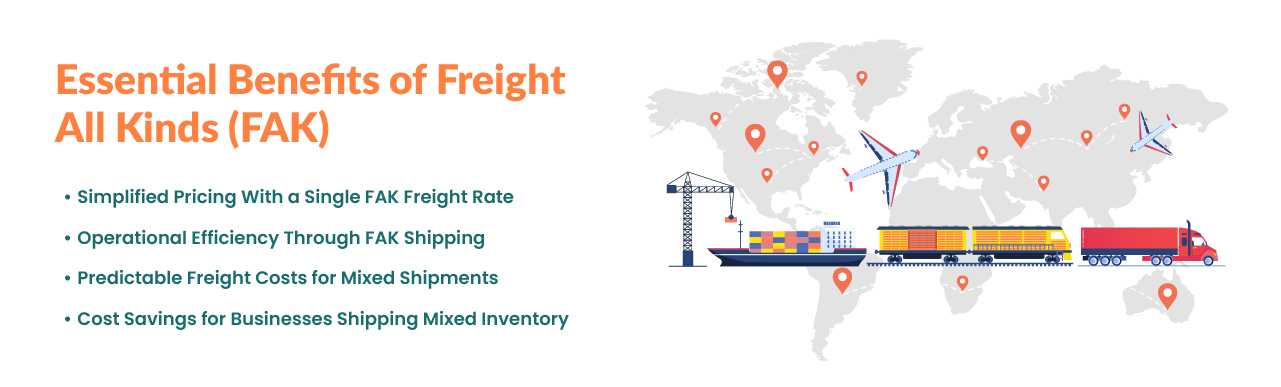
Beyond simplified billing, FAK is a unique logistics approach that delivers a wide range of benefits to help businesses enhance and align logistics and shipping workflows:
- Simplified Pricing With a Single FAK Freight Rate: The most powerful benefit of the FAK strategy is its straightforward pricing structure. Instead of assigning a freight class to every SKU, teams work with one agreed rate. That shortens quoting cycles, simplifies invoicing, and reduces the back-and-forth that often slows down billing. This approach reduces errors caused by freight classification and simplifies freight billing.
- Operational Efficiency Through FAK Shipping: A FAK helps effectively remove the process of classifying every SKU in a mixed load, giving more time to your team members to focus on improving operational speed and performance. In day-to-day operations, this usually shows up as fewer delays on the dock and less time spent reworking shipment details before dispatch. This improves overall supply chain efficiency and day-to-day transportation planning.
- Predictable Freight Costs for Mixed Shipments: A consistent rate typically means predictable shipping costs. Shippers can predict expenses more precisely when managing diverse product lines, helping companies gain better control over expenses and efficiently handle profit margins. With fewer surprise adjustments on freight invoices, finance teams can forecast margins with more confidence.
- Cost Savings for Businesses Shipping Mixed Inventory: Although FAK may not always be the cheapest option for uniform, high-volume shipments, it can be highly cost-effective for shipments consisting of varied items. By avoiding the higher individual rates that certain products might incur, For shipments with varied products, FAK can prevent higher-class items from inflating the total freight cost of the load. FAK supports long-term freight cost management for businesses shipping varied products.
How the FAK Pricing Strategy Works in the Real World
In practice, FAK agreements follow a fairly straightforward process between the shipper and the carrier. Here is the list of steps on how it works in real-world scenarios:
- Rate Negotiation: It begins with a negotiation between the shipper and carrier. Instead of pricing each product separately, both parties should agree on a single FAK rate that will apply to a broad mix of goods, based on carrier rate negotiation tied to shipment volume and consistency.
- Defining the Class Range: The FAK agreement defines which types of products or categories are covered. Since FAK removes the need for class-based pricing, a FAK rate might apply to a wide product range.
- Weight Classes: Even though FAK rates often include different product classes, shipment weights are important. For example, there might be one rate for 500–1000 lbs, another for 1001–2000 lbs, and so on. These shipment weight tiers help carriers price capacity more accurately.
- Consistent Pricing: Once everything is finalized, any shipment that fits the agreed product range and weight tier is billed at the FAK rate. This holds regardless of the mix of SKUs or their individual characteristics, making quoting and billing far more predictable.
This structure allows shippers to move mixed freight without repeated reclassification or billing disputes.
When Is the FAK Pricing Strategy Useful?
FAK is useful in specific scenarios, but it doesn’t fit every shipping profile. However, it’s essential to understand when you need to execute this strategy for the best advantage. FAK is particularly effective for eCommerce logistics, distributor shipping operations, and manufacturer freight management.
FAK works great for brands when they involve shipping a mix of products in a single shipment. If you have a diverse product catalog with varying item sizes, densities, and freight characteristics, FAK simplifies pricing and execution. Clear visibility into packaging, density, and handling needs supports better freight planning and safe transport.
For e-commerce, distributors, and manufacturers alike, FAK can be a game-changing solution, removing the complexities of rating each SKU individually, cutting down administrative workloads, and simplifying the freight billing process.
Alternatively, businesses with uniform, high-volume shipments involving easily classifiable items, traditional class-based pricing might offer better specific pricing. The best option would depend on your shipment patterns and operational goals.
Understanding Practical Considerations for FAK
Implementing FAK involves understanding a few practical aspects. It goes beyond choosing a rate itself, but also how it fits within your broader logistics strategy.
At a systems level, implementing FAK often requires alignment between pricing logic, ERP workflows, and warehouse execution layers, areas where custom solutions from NOI Technologies are commonly applied.
To begin with, not all carriers offer FAK rates; some carriers provide them selectively or under certain terms. Longer carrier relationships tend to make FAK negotiations easier, especially when shipment volumes and weight ranges are relatively stable.
Moreover, FAK eliminates the need for detailed freight classification; carriers still need a clear picture of what you’re shipping. Aspects like density, stackability, packaging, and any special handling requirements remain important for planning capacity and ensuring safe, efficient transport.
Maintaining accurate shipment data becomes easier when warehouse systems like Fulfillor centralize SKU, weight, and packaging details.
From a logistics operations perspective, FAK works best when shipment profiles are stable and carrier relationships are long-term.
Choose ShipRelax for Your FAK Shipping Needs!
Freight of All Kinds (FAK) is a valuable logistics strategy that offers a competitive edge to new-age businesses managing diverse, fast-moving shipments. By offering a single, blended rate for mixed shipments, FAK is a powerful strategy that allows brands to cut through administrative complexity, reduce administrative overhead, and plan shipping costs with greater confidence.
For brands handling varied SKUs or diverse shipping needs, or frequent mixed loads, FAK can elevate the logistics experience.
ShipRelax supports shipping cost optimization by aligning FAK agreements with real operational data.
ShipRelax is your ultimate 3PL partner that makes freight management simpler, efficient, smarter, and more. When applied intelligently, FAK becomes a powerful tool to enhance operational efficiency and strengthen your overall supply-chain strategy, allowing brands to focus on delivering products more efficiently, reliably, and affordably.
Frequently Asked Questions About Freight All Kinds (FAK)
Is Freight All Kinds (FAK) the same as Freight of All Kinds (FOAK)?
Yes. Freight All Kinds (FAK) is the industry-standard term, while Freight of All Kinds (FOAK) is a commonly used variant. Both refer to the same blended-rate freight pricing model used for mixed shipments.
Is FAK pricing cheaper than traditional class-based freight pricing?
FAK pricing is not always cheaper for uniform or single-product shipments. However, for mixed or multi-SKU shipments, it often reduces overall costs by avoiding higher individual freight class rates and billing adjustments.
Does FAK eliminate freight classification entirely?
FAK removes class-based pricing from billing, but carriers still require shipment details such as weight, density, packaging, and handling requirements to plan capacity and ensure safe transport.
What types of businesses benefit most from FAK pricing?
FAK pricing works best for eCommerce brands, distributors, and manufacturers that regularly ship mixed or multi-SKU loads and want predictable freight costs and simplified billing.