Logistics has been a transformational force behind the success or failure of big ventures. Several industries, including manufacturing, retail, ecommerce, distribution, and healthcare, benefit from a smooth and efficient supply chain ecosystem. Over the recent years, businesses have started leveraging the full potential of well-planned logistics management strategies to gain a strategic advantage and support end-to-end supply chain optimization.
Integrated logistics management takes this even further by combining procurement, transportation, warehousing, inventory flows, and real-time information sharing into one unified process. This integrated supply chain approach strengthens operational efficiency, logistics visibility, customer experience, and overall profitability.
So, what do you mean by integrated logistics management, and how do enterprises unleash their maximum potential? This article outlines a practical approach for executing integrated logistics management and highlights the significance of having a robust fulfillment software solution to achieve smooth and scalable logistics and supply chain operations.
What Is Integrated Logistics Management?
Integrated logistics management is a well-defined approach that unifies procurement, production, warehousing, inventory movement, and distribution into a single, integrated logistics strategy. This strategy focuses on connecting every function, department, and resource to work as a single, end-to-end supply chain system, supported by real-time, two-way data sharing and supply chain visibility across all SCM processes. The prime goals behind this approach are to accelerate product delivery efficiency, enhance operational coordination, and meet customer needs effectively.
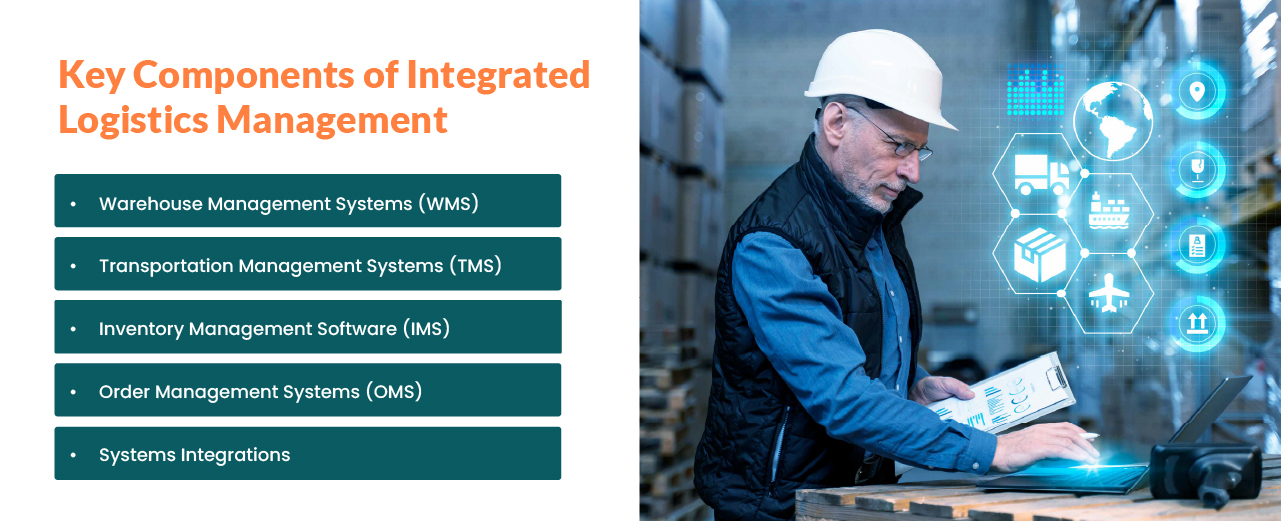
Key Components of Integrated Logistics Management
Integrated logistics management combines advanced supply chain technologies to remove inefficiencies and ensure an effortless, end-to-end logistics and supply chain workflow. ERP systems, IoT applications, and cloud-based supply chain platforms integrate critical systems such as transportation management, warehousing, inventory control, and order fulfillment software solutions to enable real-time visibility, data-driven decision-making, and automated, streamlined operations across the supply chain.
Below are essential technology components that work together to optimize logistics efficiency, enhance supply chain visibility, and strengthen operational performance:
1. Warehouse Management Systems (WMS)
Warehouse management is a core component of integrated logistics management, covering daily activities essential for smooth warehouse operations. This includes receiving inventory, warehouse space optimization, labor management, inventory tracking, order fulfillment, and other tasks that support efficient movement of goods from storage to the final destination.
Modern WMS solutions can seamlessly integrate with systems like Transportation Management Systems (TMS), Inventory Management Systems (IMS), and order fulfillment platforms. With synchronized workflows, businesses can streamline distribution, reduce delays, and support fast delivery models such as next-day and same-day shipping.
An integrated WMS improves operational accuracy, boosts customer satisfaction, strengthens brand loyalty, and enhances profitability through more reliable warehouse operations.
2. Transportation Management Systems (TMS)
TMS supports transportation planning and execution across a complex network of suppliers, warehouses, and customers. Companies rely on TMS for carrier communication, route optimization, freight tracking, documentation, regulatory compliance, dock scheduling, and more.
When advanced routing algorithms work with TMS software, they identify the most efficient delivery routes by analyzing distance, traffic patterns, supplier locations, and delivery windows, reducing transit times and lowering fuel costs.
Integrating TMS with WMS, IMS, or other logistics systems also reduces the need for safety stock, freeing up working capital and warehouse space.
Sustainability is another advantage, as optimized routing reduces vehicle usage, fleet emissions, and transportation-related carbon footprint.
3. Inventory Management Software (IMS)
Inventory management sits at the core of integrated logistics. IMS ensures businesses maintain product availability in the right quantities, at the right time, and in the right locations. It maintains the balance between supply and demand, working closely with procurement teams to manage optimal stock levels.
By integrating IMS with WMS and TMS, businesses can prevent stockouts or overstocking, reduce carrying costs, and strengthen overall supply chain responsiveness.
Advanced platforms like FulFillor offer inventory optimization, real-time visibility, demand forecasting, analytics, and automation capabilities, helping brands gain a competitive edge.
4. Order Management Systems (OMS)
Order management connects customer demand with supply chain execution. OMS handles logistics functions such as inventory availability checks, transportation planning, warehouse picking and packing, shipping, and order tracking.
Integrated OMS solutions coordinate product availability, warehouse tasks, and transportation initiation to enable accurate, on-time deliveries.
With end-to-end order integration, businesses can reduce lead times, eliminate manual errors, and significantly improve operational efficiency.
5. Systems Integrations
Seamless system integrations are fundamental to building an efficient and resilient integrated supply chain. Connected systems enable real-time data flow, analytics, and informed decision-making across departments, partners, and platforms.
Integrated logistics aligns processes and goals among suppliers, manufacturers, distributors, and logistics partners. This leads to improved transparency, better inventory control, faster transportation processes, and enhanced information exchange.
ShipRelax, a 3PL provider, leverages the Fulfillor WMS platform to enhance collaboration through shared visibility into KPIs, inventory levels, and order status. This supports better planning, reduces risk, improves transparency, and strengthens overall logistics performance.
Collaboration between 3PL providers and their clients helps reduce operational costs, improve service quality, and enhance supply chain innovation.
ShipRelax + FulFillor: A Unified Approach to Integrated Logistics Excellence
ShipRelax is a specialized 3PL logistics service provider that helps businesses navigate complex fulfillment and supply chain challenges. They offer customized ecommerce fulfillment solutions and use Fulfillor, an end-to-end fulfillment technology platform, to address issues such as fragmented data across departments, inefficient workflows, and a lack of real-time visibility.
To solve these challenges, ShipRelax implements the cloud-based FulFillor order fulfillment management platform, which unifies warehouse management, inventory management, order processing, and integrations with customers’ systems. With its 3PL client portal, 3PL management tools, inventory management capabilities, and warehouse management software, Fulfillor ensures smooth, accurate, and efficient logistics and fulfillment operations.
To fully benefit from integrated logistics, ecommerce brands should consider partnering with an experienced third-party logistics provider like ShipRelax that offers strong warehousing expertise and leverages advanced fulfillment technology to improve operational performance.
Want to know how we help brands increase revenue, enhance customer satisfaction, and streamline logistics operations? Connect with our team today to learn more!
Frequently Asked Questions (FAQs)
What metrics show the success of integrated logistics initiatives?
Success is typically measured through reduced lead times, higher on-time delivery rates, lower transportation and handling costs, and improved customer satisfaction. Additional performance indicators include inventory turnover, order accuracy, warehouse efficiency, and overall supply chain productivity.
What challenges do companies face in integrated logistics management?
Common challenges include coordinating activities across multiple supply chain systems, managing demand fluctuations, achieving smooth system integrations, aligning internal and external stakeholders, and maintaining real-time supply chain visibility without strong digital tools.
How does integrated logistics improve overall logistics management?
Integrated logistics improves operations by connecting procurement, warehousing, transportation, and distribution activities. This alignment enhances inventory performance, stock accuracy, and order fulfillment speed, while reducing the risk of both overstocking and stockouts.